
What to Check Before Buying a Used E-Bike
A used e-bike can still be a smart buy, but this is one category where the battery story, system support, and ownership paperwork matter more than a shiny frame and a friendly seller.
Quick take
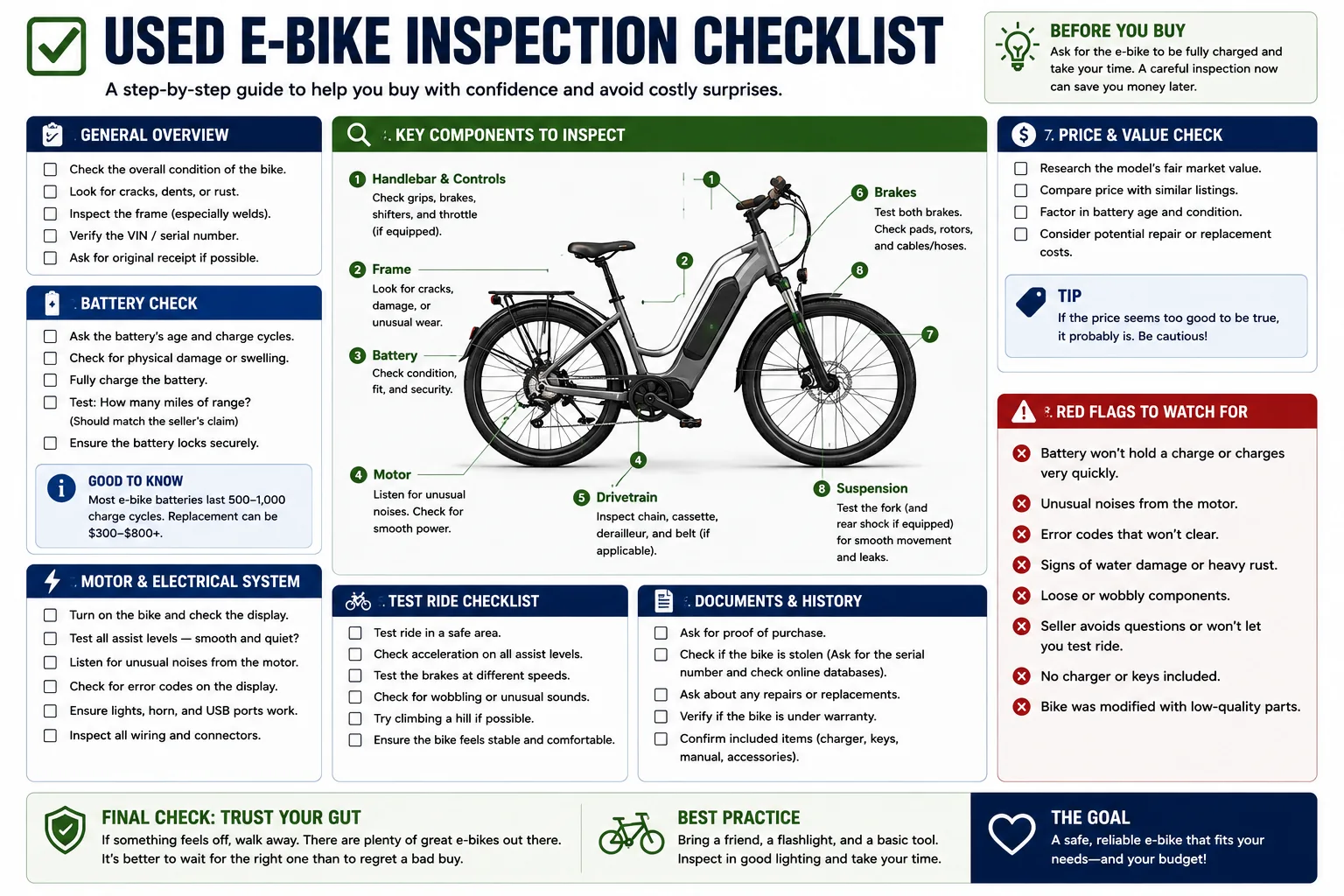
The safest used e-bike is one with a believable battery history, a supportable motor system, an intact serial number, and a seller who can prove what the bike is. Cosmetic tidiness is nice. It is not the hard part.
Start with the battery and motor system, not the paint
The expensive risk on a used e-bike is usually electrical, not cosmetic. Scratches, worn grips, and a few chips in the paint are normal. A vague battery story, missing charger, mysterious display errors, or a bike that has been "worked on" by an unknown person is where the real money can disappear.
If the bike uses a major system like Bosch, treat that as a real advantage. Bosch now offers an official battery check tool where buyers can enter the battery serial number to see whether Bosch has information about defects or repair attempts. That does not make every used Bosch bike safe by itself, but it is exactly the kind of supportable paper trail you want before money changes hands.
Ask these questions before you go look at the bike
- How old is the bike and how often was it ridden? A three-year-old bike ridden lightly is different from a one-year-old bike used for hard daily delivery duty.
- Is the original charger included? Missing chargers often mean a sloppier ownership story than the seller admits.
- Has the battery ever been opened, repaired, rebuilt, or replaced? Bosch explicitly warns that e-bike batteries should not be opened by riders and that improperly opened batteries can create later fire risk.
- Can you show the serial number and proof of purchase? A seller who hesitates here is making the bike less attractive immediately.
- Is there still dealer or brand support for this model? A cheap used bike is not cheap if the display, battery mount, or controller becomes impossible to source.
What to inspect in person
- Battery fit and housing: look for cracked plastic, swelling, damaged terminals, loose fit, or tape-and-glue improvisation.
- Charging behavior: ask to see the battery charge normally with the correct charger, not just power on for a few seconds.
- Display and controls: make sure the screen, buttons, assist modes, lights, and walk mode all behave normally if equipped.
- Motor feel: during a short ride, power delivery should feel predictable, not surgy, grinding, or intermittent.
- Brake condition: heavy e-bikes are hard on pads and rotors, so weak braking is not a small issue.
- Frame and fork: check weld areas, dropouts, rack mounts, and child-carrying points closely if it is a cargo or family bike.
- Wheels and tires: damaged rims, spoke tension problems, and cheap replacement tires can hint at deferred maintenance everywhere else.
How to judge the battery story realistically
The wrong question is "Does the battery still turn on?" The better question is "Would I feel comfortable owning this battery indoors for the next few years?" Ask how it was stored, whether it lived in a garage through extreme heat or cold, whether range has dropped noticeably, and whether it has ever shut down unexpectedly under load.
Be especially careful when the seller talks in soft phrases like "still seems fine to me" or "I never really tracked range." That is not proof of anything. On the other hand, a seller who can describe normal charging habits, winter storage, approximate mileage, and why they are selling the bike is giving you a much stronger ownership signal.
Do not skip the legal and support checks
Make sure the serial number is intact and matches any paperwork. Confirm the charger is the right one for that battery system. Check whether the brand is still operating, whether replacement batteries are still sold, and whether local shops will service that system. Used gets much safer when the bike still belongs to a real support ecosystem.
This matters even more for direct-to-consumer brands and discontinued models. A great deal on a bike with no realistic battery replacement path is often just delayed regret.
When to walk away
- the seller cannot explain the battery history
- the serial number is missing, altered, or strangely avoided
- the charger is wrong, generic, or missing
- the bike throws system errors, cuts in and out, or will not demonstrate a normal charge
- there are signs the battery was opened or the wiring was modified
- the whole pitch is "it probably just needs a little tune-up" on an electrical issue
Bottom line
A good used e-bike usually comes with a boring, believable story: original charger, intact serial number, supportable system, normal wear, and an owner who can answer plain questions directly. Buy the paper trail and battery confidence first. Then worry about the paint.